Nodal
Defined-contribution healthcare is the next major shift in how employers fund benefits, and almost no one knows how to actually use HSA, FSA, HRA, or ICHRA dollars at the moment of purchase. Nodal is the chip that classifies eligibility in the page, the autopilot that recovers what slipped through, and the rules infrastructure that keeps the whole thing honest.
Overview
Employers spend a trillion dollars a year on benefits, and almost none of it gets used on purpose. HSA, FSA, HRA, and ICHRA each carry their own rules; most carriers paper over the gap with reimbursement forms. Nodal moves the answer to the moment of purchase: a chip inside the PDP classifies the merchant and SKU and tells the employee what their dollars cover before they tap pay.
Approach
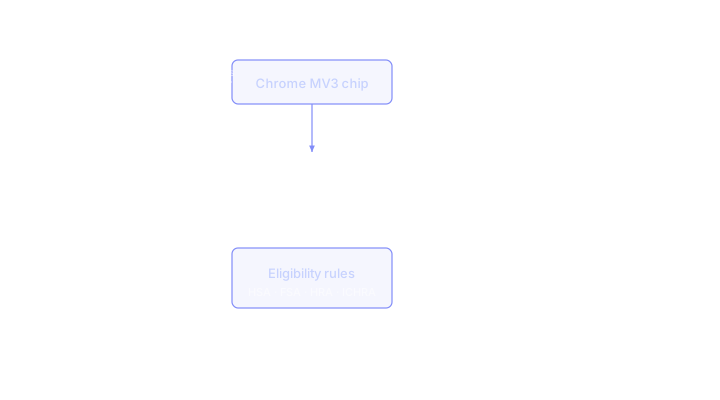
The rules engine is a shared Zod schema package consumed by the chip, backend, and marketing site, so a verdict never drifts between surfaces. Classification runs in two tiers: a small on-device model handles the common case in milliseconds and keeps PHI off the network; Gemini Flash takes the long tail server-side. Stack is Astro for marketing, Chrome MV3 for the chip, Hono on Node for the backend, and a small CLI that publishes immutable rule bundles.
Outcome
Marketing site is live at nodalhealth.ai. The chip works end to end against a seed corpus of merchants. Two self-insured employers and a TPA are in design-partner conversations. ICHRA rules are still expanding with benefits counsel before general availability. The bet: DC healthcare is where 401(k)s were before auto-enrollment, and the missing layer is software that turns a stipend into a usable balance.
Reflections
Hardest call: building the rules engine as its own package before the chip had a real merchant to classify against. Felt premature for two months. By month three it was the only reason the chip and backend could ship in parallel. Easiest call: no reimbursement-form OCR. Nobody loves that workflow, and competing on it would have been a cheaper product and a slower wedge.